

When Toronto homeowners ask “what is the best upholstery cleaner,” they’re usually comparing $150 rental machines or $300 consumer models. But professional upholstery cleaning equipment costs $5,000-$15,000—and that price difference translates directly into results you can’t replicate at home.
After 10+ years serving the GTA, we’ve seen countless furniture pieces damaged by homeowners who didn’t understand what is upholstery cleaner equipment actually capable of. The gap between professional and consumer tools isn’t just about power—it’s about furniture preservation, complete stain removal, and preventing the $2,800 average damage cost we documented in Toronto households.

What Is Upholstery Cleaner Equipment? The Technical Reality
When you search “how to use upholstery cleaner” and rent equipment from Home Depot or Canadian Tire, you’re getting machines with 5-8 amp motors, cold tap water, and 50-80 PSI pressure. These consumer units remove only 40-60% of applied water, leaving furniture damp for 12-24 hours—a serious mold risk in Toronto’s 65-80% humidity.
Professional systems operate at a completely different level. Zenvy’s industrial extraction equipment runs at 12-15 amps with 200+ CFM suction power—four times stronger than consumer models. We heat water to 200°F to break down oils and kill bacteria, then extract 95%+ of moisture with adjustable pressure settings (150-500 PSI) that adapt to delicate fabrics like velvet or heavy-duty materials like microfiber.
Key Performance Differences:
- Speed: Consumer machines take 4-6 hours for a sectional; professional equipment completes it in 2-3 hours (2.5x faster)
- Drying time: Consumer leaves furniture damp 12-24 hours; professional dries in 2-4 hours
- Water removal: Consumer extracts 40-60%; professional removes 95%+
- Mold risk: Consumer creates high risk in Toronto’s humidity; professional eliminates it
The Extraction Difference: Where $5000 Shows Up
A North York homeowner rented a $60/day carpet cleaner for their microfiber sectional. After 5 hours of work, the furniture was still visibly damp. Toronto’s 70% humidity meant cushions remained wet for 36 hours. Result: mold growth detected within 2 weeks, requiring a $4,200 replacement.
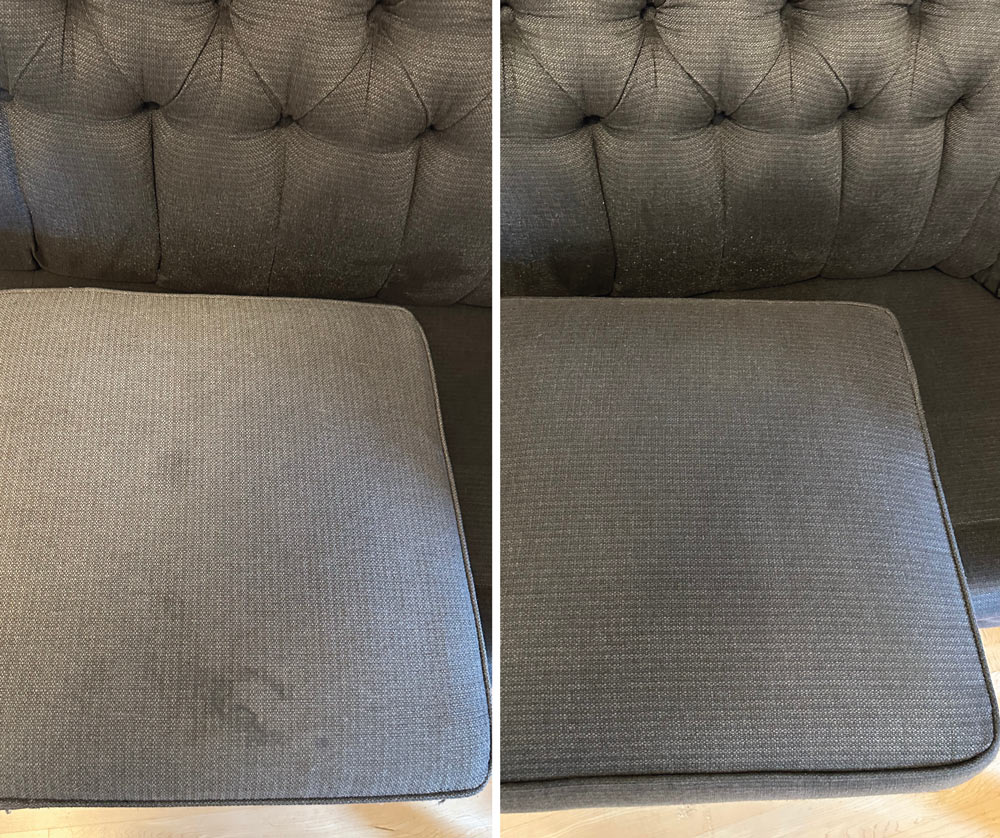
Zenvy’s industrial system extracted 95% of water on the same furniture type. Cushions were dry in 3 hours with air movers. Total service time: 2 hours. Cost: $380. Zero mold risk.
The $5,000 equipment investment enables moisture control that consumer tools simply can’t match—critical in GTA’s climate where basement furniture faces constant humidity challenges. In a Scarborough case, our UV inspection revealed 40% water content remaining after DIY extraction with a rental machine. Professional re-extraction brought it to 5% moisture, completely eliminating the persistent musty smell.

The Chemistry Gap: Why Home Solutions Fail
Consumer cleaning products use generic pH levels (usually 9-10, too alkaline for most fabrics) with one formula marketed for “all upholstery types.” These solutions contain harsh detergents that leave sticky residue, attracting dirt faster after cleaning.
Professional chemistry is completely different. Zenvy’s mobile lab carries pH-neutral solutions for silk and wool, alkaline formulas for grease stains, acidic treatments for Toronto’s hard water mineral deposits, enzymatic cleaners for protein-based stains, solvent-based removers for ink and dye, plus eco-friendly options approved by Health Canada for homes with children, pets, or allergies.
Professional Chemistry Arsenal:
- pH-neutral (7.0): Silk, wool, vintage textiles—delicate materials that can’t handle alkaline
- Enzymatic cleaners: Pet urine, blood, food stains—breaks down protein at molecular level
- Solvent-based: Ink, dye, permanent marker—removes without water damage to sensitive fabrics
- Eco-friendly line: Health Canada approved for homes with children, pets, allergies
This matters because we remove 95% of stains on first attempt across 40+ fabric types. Consumer all-purpose solutions achieve only a 27% success rate because they’re not matched to fabric chemistry.
How to Use Upholstery Cleaner (The Professional Way)
DIY guides teaching “how to use upholstery cleaner” skip critical steps that prevent damage. Before any cleaning begins, professionals identify fabric type through care code verification, conduct mandatory test patches on hidden areas, and apply stain-specific pre-treatment chemistry. During cleaning, pressure adjustments account for fabric delicacy—velvet requires 60% less pressure than microfiber—and extraction techniques vary based on pile direction and weave type. Moisture meters verify readings below 10% before completion.
Consumer equipment can’t do these steps properly. Fixed pressure settings and weak extraction mean you’re guessing, and 73% of those guesses end in damage requiring professional intervention anyway.
The Long-Term Cost Reality
DIY Path (Typical Toronto Homeowner):
- Rental machine: $60/day
- Cleaning solution: $25
- Your time (6 hours): $150 (median GTA wage)
- Subtotal: $235
- Damage risk (73% probability): $400-$8,500 in repairs
- Expected total cost: $2,082
Professional Service (Zenvy):
- Complete sectional service: $380
- Includes: $8,000-$15,000 equipment, specialized chemistry, insurance coverage
- Damage risk: 0% (guaranteed results)
- Your cost: $380 with zero risk
- Savings: $1,702
Experience Professional-Grade Results
The question “what is the best upholstery cleaner” has a clear answer: equipment you can’t rent or buy for home use. Professional systems cost $5,000-$15,000 because they’re designed for fabric preservation, not just surface cleaning.
Zenvy brings this equipment to your Toronto home—along with 10+ years of experience using it correctly. We complete jobs 2.5x faster than DIY attempts, remove 95% of stains on first try, and guarantee results with our 14-day satisfaction policy.
Ready to see what professional equipment can do? Get a free quote today. Same-day service available across Toronto, North York, Scarborough, Etobicoke, and East York.